
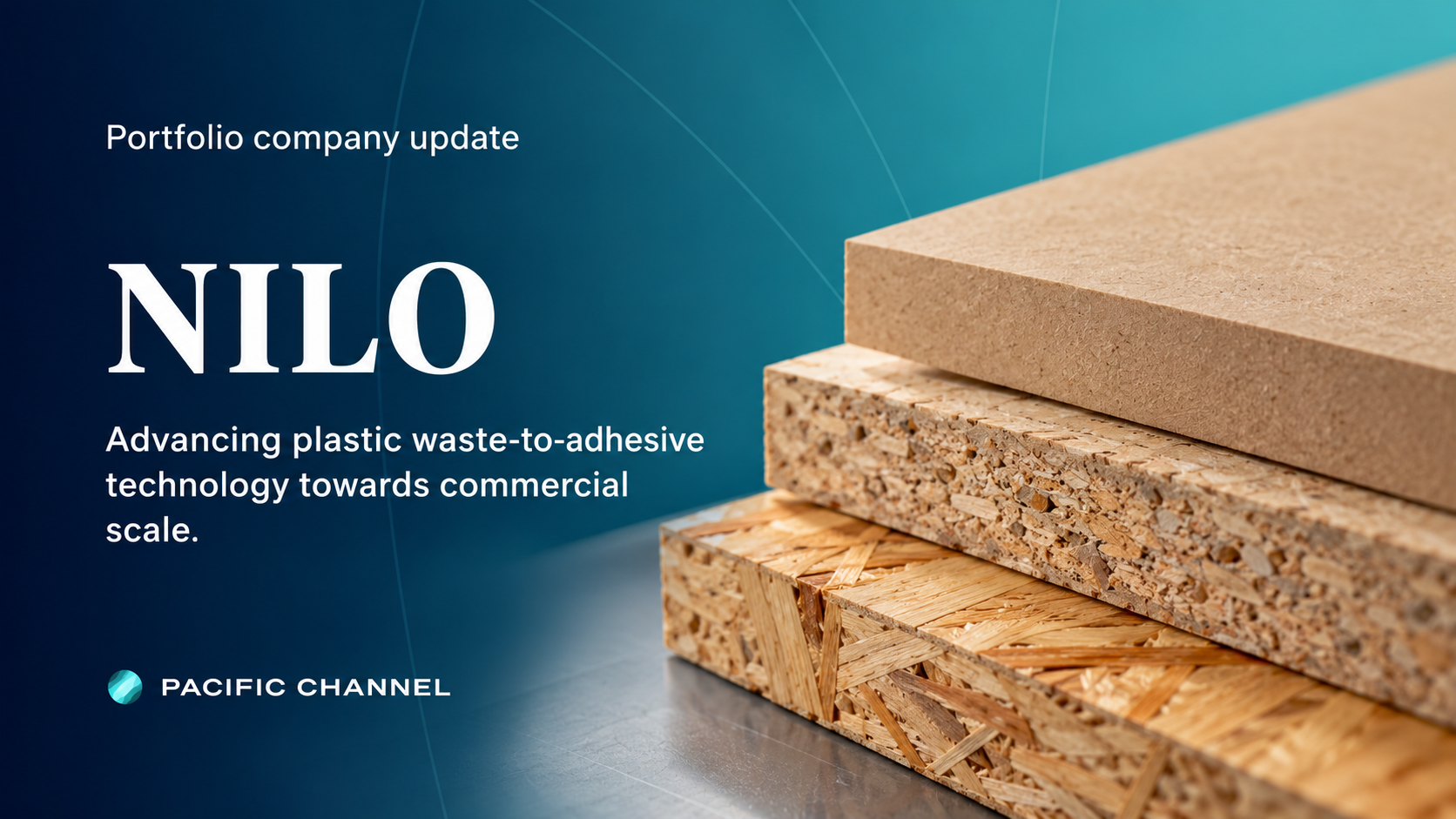
When Pacific Channel and Inter IKEA Group led NILO's $13m Series A capital raise in 2024, the Auckland deep-tech company had an ambitious proposition: take difficult-to-recycle plastic waste and turn it into a commercially competitive industrial adhesive.
Less than two years later, a recent presentation from the NILO team to Pacific Channel showed how that idea is progressing from technology development towards industrial scale.
The opportunity comes from bringing together two significant global challenges. Vast quantities of plastic have few viable recycling options, while manufacturers of engineered wood products such as MDF and particleboard are looking for alternatives to conventional adhesives.
NILO has developed a technology that uses difficult-to-recycle plastics as the raw material for an industrial adhesive that can be incorporated into existing wood-panel manufacturing.
In effect, it takes a problematic, low-value waste stream and turns it into something industry already needs.
Since the Series A, the focus has increasingly shifted from proving the technology to proving the business around it. That means demonstrating that NILO's adhesive works at commercial scale, can be integrated into existing manufacturing processes, has reliable sources of plastic feedstock and delivers an attractive proposition for customers.
The company's progress over the past two years shows those pieces beginning to come together.
Proving it in the real world
NILO has moved beyond laboratory testing into small scale trials with domestics and overseas partners, including work in Poland with IKEA, and in IHD lads in Germany that has demonstrated its adhesive can perform in PB,OSB and MDF manufacturing. It is now preparing for larger adhesive production lines to enable commercial trials with international manufacturers.
Alongside these trials, NILO has been building the relationships it will need to commercialise the technology. Its partnership with industrial resin manufacturer AICA NZ provides a pathway for wood-panel manufacturers to introduce NILO's technology, while its work with Plasback NZis helping establish access to agricultural plastics that would otherwise be difficult to recycle.
Earlier this year, SGS also independently validated NILO under the Plastic Pollution Reduction Standard, providing external verification of the plastic waste diverted through its process.
Together, these milestones show a company moving beyond proving its science and starting to build the wider system required to supporta commercial business - customers, manufacturing, feedstock and independent validation.
The next challenge: scale
NILO's next phase is more ambitious - setting up a large scale continues adhesive line in theAuckland pilot plant show casing end to end production at commercially relevant scale.
The company has several development partnerships in place which will step wise lead to large scale industrials trials and the first commercial plant and revenues.
Furthermore, the company has plastic credit certification work underway for the Verra market and there is significant interest already from potential credit purchasers.
This is where the investment proposition becomes particularly interesting. If NILO can demonstrate that its technology works economically at industrial scale, the opportunity is global and the adhesive market is US$18 Billion. Given petrolchemical supply chain challenges and price spikes turning domestic plastic waste into an adhesive has never looked so good. Its model is designed to be replicated internationally, locating production close to sources of plastic waste and the manufacturers that can use the resulting adhesive.
For Pacific Channel, this potential to scale has always been central to the NILO opportunity.
The value isn't simply in finding another usefor plastic waste, but in creating a commercially useful product for an established global industry and developing a model capable of being repeated in multiple markets.
The company's progress since the Series A is bringing that ambition closer to reality. There is still considerable work ahead as NILO moves through larger trials and towards commercial production, but the questions it is now working to answer are increasingly those of scale, customers and economics rather than whether the underlying technology works.
NILO is planning a Series B capital raise in Q3 2027.
To find out more about NILO's technology click here: NILO: Industrial adhesives made from plastic waste
