
Great science is fundamental to deep tech. But at Pacific Channel, we also invest in great people - founders and teams with the experience, ambition and commercial discipline to turn breakthrough science into globally significant businesses.
That combination is particularly important in medtech, where even outstanding technology must navigate clinical validation, regulation, quality systems, reimbursement and market adoption before it can reach patients at scale.
It is one of the reasons we invested in Orbis Diagnostics - and why we continue to invest.
The challenge
Orbis is tackling a fundamental challenge in healthcare: how to bring sophisticated diagnostic testing closer to the patient.
Its first application is hepatitis B (HBV), where Orbis aimsto become a world-first provider of point-of-care diagnostics for the primary HBV blood markers.
The need is significant.
World Hepatitis Alliance President Dee Lee says low diagnosis rates remain a major barrier to addressing hepatitis B globally:
"With only 27% of the 240 million people living with hepatitis B diagnosed we are facing a public health crisis. To stop rising mortality caused by hepatitis B, and reach the World Health Organization 2030 hepatitis elimination goals, and from the perspective of a person living with hepatitis B almost my whole life, I urge that we work together to scale up access to quality hepatitis B tests."
Orbis is developing a triple-panel point-of-care test designed to measure the primary hepatitis B blood markers from a minimal blood sample, bringing testing closer to patients and potentially enabling people to be diagnosed and connected with appropriate care more quickly.
For Hepatitis B Foundation CEO Chari Cohen, the potential impact is significant:
"Having a triple panel point of care diagnostic test for hepatitis B would be transformational, overcoming a significant barrier that would allow us to test, diagnose, and link millions more people with medical care and treatment that could save their lives.
"We are pleased to see Orbis making great strides towards providing us with a key tool that will help eliminate hepatitis B in the U.S. and around the world."
The solution
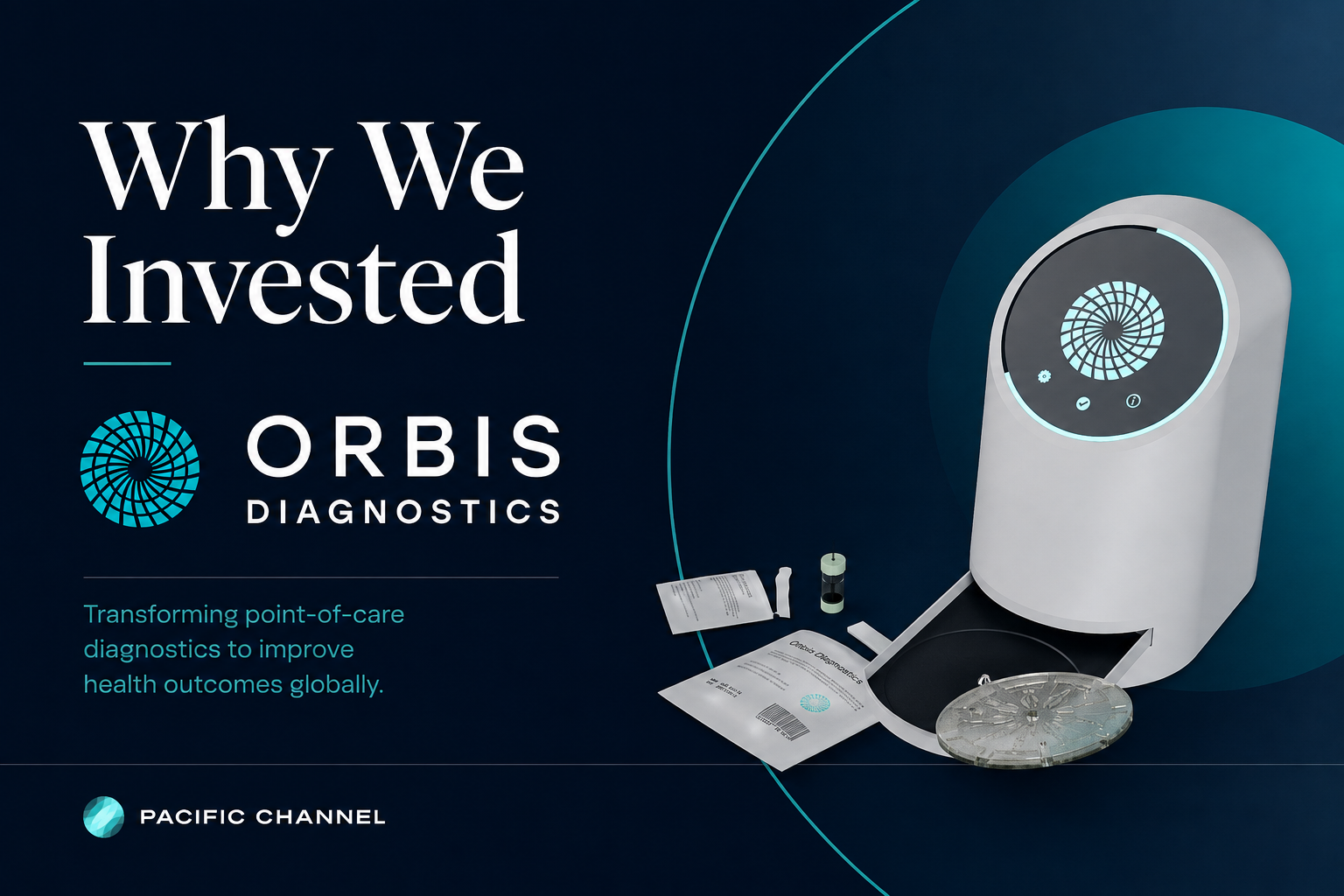
At the heart of Orbis is the Pulse, a compact diagnostic instrument combined with a proprietary disposable disc containing the analytical reagents required for each test.
The ambition is to deliver lab-quality blood testing at the point of care, beginning with hepatitis B but ultimately extending across a much broader range of diagnostic applications.
But the technology is only part of why we invested.
We had already worked with Orbis founder and CEO Professor Cather Simpson through our investment in Engender, which was acquired in 2018. We had seen first-hand the value of combining deep scientific expertise with a strong focus on commercialisation.
That experience is evident in the way Orbis has been built.
As Cather recently told BusinessDesk:
"If you're going to make an impact in medical diagnostics, the research isn't actually the key part. You have to get the regulatory stuff right. You have to get the commercial pull right."
Rather than developing the technology first and addressing the pathway to market later, Orbis has considered regulation, quality, reimbursement and the commercial model alongside product development.
Early in its journey, the company worked with a Boston-based company to establish that its revenue model worked and that there was a reimbursement pathway in the US.
Orbis has also achieved ISO 13485:2016 accreditation for its quality management system, recently successfully passed its first Surveillance Audit, and engaged early with the US Food and Drug Administration through its Q-submission process.
These are important commercial milestones.
A diagnostics company can progress through FDA approval but still be unable to sell if the necessary quality systems are not in place. Addressing those requirements early represents significant commercial de-risking and demonstrates the benefit of building with the end market in mind.
Why we continue to invest
Our conviction in Orbis is also conviction in the people building it.
One of the benefits of working with experienced founders is that they bring the lessons of previous commercialisation journeys to the next company. They know where the hurdles are likely to emerge, the questions that need to be answered and where time and capital can be lost.
Orbis has continued to demonstrate that discipline.
The company has completed two hepatitis B clinical trials. Its first demonstrated the accuracy and repeatability required to support commercial viability, while its second, undertaken with the New Zealand Hepatitis Foundation, confirmed that capillary blood tests produced the same results as venous blood draws.
A third trial is planned to demonstrate quantitative measurement - determining not simply whether a biomarker is present, but how much is present. This capability could significantly broaden the applications for the Orbis platform.
For us as an investor, this progress matters. Orbis has continued to use capital to achieve milestones that progressively address technical, clinical, regulatory and commercial risk while moving the company closer to market.
A platform opportunity
Our investment thesis has always extended beyond a single hepatitis B test.
HBV provides Orbis with a clearly defined first application and an important global problem against which to prove its technology.
The potential of the underlying platform is considerably broader.
Orbis is already exploring an enzyme test for metabolic fatty liver disease and developing high-sensitivity molecular testing of RNA and DNA, which could ultimately create opportunities in areas including cancer screening and viral load measurement.
The longer-term vision is what Cather describes as a "one-box, many-test solution" - a single diagnostic platform capable of supporting multiple tests through its proprietary disposable discs.
Orbis is now raising up to $11 million in Pre-Series A capital to complete development of Pulse 1.0, secure strategic international partnerships, expand its high-sensitivity molecular testing R&D and support its planned move towards commercialisation in the US.
Pacific Channel is a cornerstone investor in the round alongside two overseas-based high-net-worth individuals.
For us, continuing to invest reflects both what Orbis has achieved and our conviction in the team and the opportunity ahead.
We invest in breakthrough technologies capable of solving significant global problems. But we also invest in great people.
The strongest deep-tech opportunities bring those two things together: differentiated science with experienced, ambitious people who understand what it takes to translate that science into a successful global business.
In Orbis, we believe we have both.
